
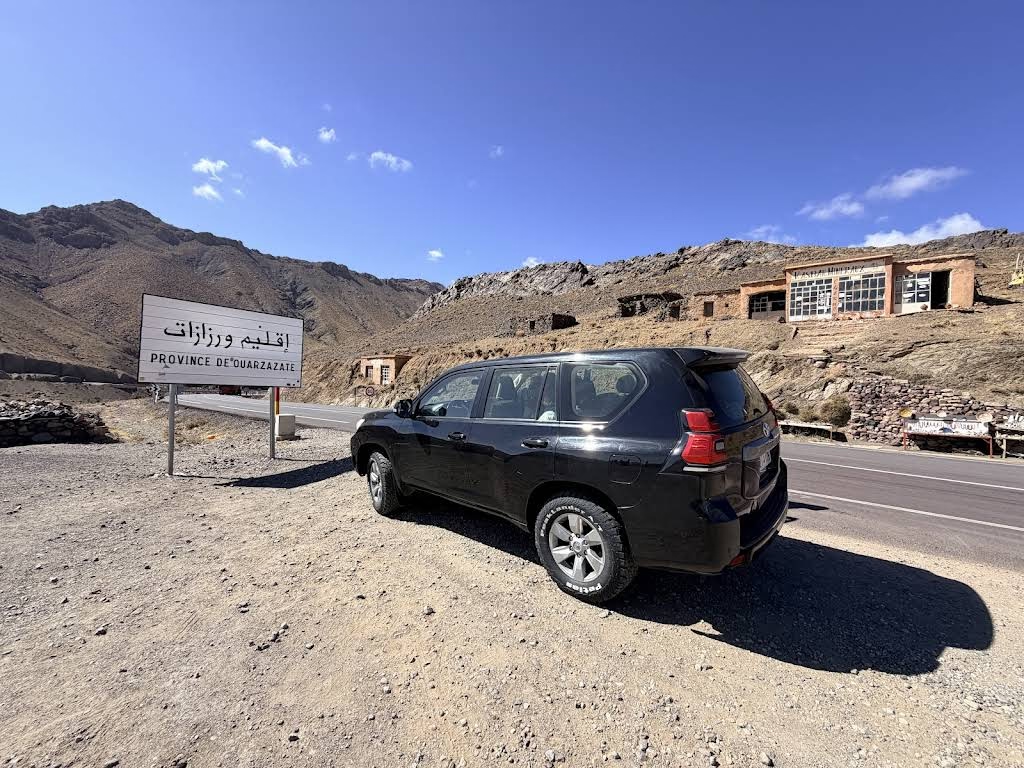
On the map, 200 kilometres separate Marrakech from Ouarzazate. On the ground, it's one of the most concentrated itineraries in Morocco: a pass at 2,260 metres, a valley carved by the trans-Saharan caravans, earthen kasbahs that seem to rise straight out of the rock, and landscapes that Hollywood has turned into open-air film sets.
The paved road can be done in a city car — that's no secret. But what makes this road trip truly memorable are the detours only a 4x4 can take: the historic track from Télouet to Aït Ben Haddou via the Ounila Valley, the isolated kasbahs on the ridges, the Fint oasis. Here's how to structure this road trip over 2 or 3 days.
The Itinerary at a Glance: What to Know Before Setting Off
- Total distance: about 200 km as the crow flies, 280–320 km counting the off-road detours.
- Ideal duration: 2 to 3 days. Doing the round trip in a single day is possible but misses 80% of what makes this road trip interesting.
- Best time: October to May. The Tizi n'Tichka can be snowy in December–January, and the Ounila track becomes difficult after heavy spring rains. For a more detailed calendar, see our guide to the best season for a 4x4 road trip in Morocco.
- Type of vehicle: a 4x4 isn't compulsory if you stay on the tarmac, but it's essential the moment you want to take the historic Télouet → Aït Ben Haddou track, reach Fint Oasis, or push on toward the isolated kasbahs. A city SUV (Dacia Duster 4x2, Kia Sportage) isn't enough on these tracks.
- Driving difficulty: the paved road is technical without being dangerous (tight bends at the Tizi). The tracks are accessible to an attentive driver without extreme off-road experience, but they call for a truly suitable vehicle and caution on the wadi crossings.
Day 1: Marrakech → Télouet via the Tizi n'Tichka (120 km, ~4h drive)
Set off early in the morning from Marrakech, ideally before 8 a.m. to avoid the traffic leaving the city. The N9 heads out of the metropolitan area toward the southeast and begins climbing gradually toward the first foothills of the High Atlas.
The ascent of the Tizi n'Tichka is the backbone of this first day. Allow about 2 hours from Marrakech to reach the pass at 2,260 metres — a recently upgraded road, wide and well signposted, but with tight bends that require attention. The stopping points are worth the detour: the village of Asni, the viewpoint over the Ouirgane Valley, and of course the summit of the pass itself for the panoramic photo.
It's on the way down that the road trip shifts up a gear. About 10 km after the pass, a secondary road (well marked) branches off east toward Télouet. Most tourists carry straight on toward Ouarzazate — let them go. You take this turn-off.
The Kasbah of Télouet is one of the most spectacular in Morocco, and paradoxically one of the least visited. The former residence of the Glaoui, lords of the Atlas in the early 20th century (the last great pasha of Marrakech), it has remained largely intact — carved cedar ceilings, zellij tilework, stucco. The visit takes 1 to 1.5 hours with a local guide.
Overnight in Télouet in one of the village's Berber guesthouses. The options are simple but authentic, with a home-cooked dinner and a welcome in the Berber tradition (reckon on 300–500 MAD per room with half board). It's also the ideal starting point for the Day 2 track.
Day 2: Télouet → Aït Ben Haddou → Ouarzazate (~80 km, full day)
This is the emotional heart of the itinerary, and this is where the choice of vehicle makes all the difference.
Two options to reach Aït Ben Haddou from Télouet:
Option 1: the paved road (back onto the N9, then down to Aït Ben Haddou). Reckon on 1.5 hours of driving. Fast, risk-free, suitable if you're in a hurry or if the weather is bad.
Option 2: the historic track of the Ounila Valley. This is the old caravan route that linked Télouet to Aït Ben Haddou before the Tizi n'Tichka was cut through in the 1930s. About 50 km of track, 2.5 to 3 hours of driving depending on conditions. It's this track that alone justifies renting a real 4x4.
The track crosses a succession of Berber villages clinging to the sides of the valley, runs along seasonal wadis, and passes at the foot of isolated kasbahs that appear in no tourist brochure. Technically, the track is demanding without being dangerous — you alternate between rocky sections, dry wadi crossings (outside the spring rains), and stretches of packed earth. Adapting your driving to these conditions is part of the pleasure of the journey.
Aït Ben Haddou appears at the end of the track like a vision: a ksar of ochre earth clinging to a hill, UNESCO-listed since 1987, the setting for Gladiator, Prince of Persia, Game of Thrones. Field tip: arrive before 11 a.m. to avoid the crowds from the tour buses, park at the bottom of the village, cross the river on foot, and climb to the top of the ksar.
After lunch in Aït Ben Haddou, reckon on 30 to 40 minutes of driving to reach Ouarzazate. Check in in town or at a riad on the outskirts. If time allows in late afternoon, the Kasbah Taourirt, right in the town centre, is worth an hour's visit.
Day 3: Ouarzazate Loop or Dadès Valley Extension (optional)
Two options depending on the time available and the mood.
Option 1: the Ouarzazate loop and return. The morning lends itself perfectly to an excursion to Fint Oasis, 20 minutes south of Ouarzazate. The track to get there is short but demanding — a 4x4 is essential, no crossover. The oasis itself is a little gem: a dense palm grove nestled in a rocky canyon, Berber villages with earthen houses, an atmosphere a world away from the tourism of Aït Ben Haddou. Return to Marrakech in the afternoon via the Tizi n'Tichka — reckon on 4 hours.
For those starting their road trip in the other direction, 4x4 rental in Ouarzazate is also possible: our agency delivers the vehicles directly in town or at the airport, which allows you to do the itinerary in reverse or extend it southward.
Option 2: extension toward the Dadès Valley. From Ouarzazate, the Road of a Thousand Kasbahs runs east toward Boumalne Dadès and the legendary gorges. Reckon on 2 hours of driving. This is where this road trip takes on another dimension, and it's also the gateway to a longer raid that can take you all the way to Merzouga and Erg Chebbi.
Field Tips for This Itinerary
Don't underestimate the Tizi n'Tichka. Even after being upgraded, this road requires 2 hours of sustained attention. In December–February, check the weather the day before — snow and black ice are possible at the pass.
The Ounila track can be cut off after heavy rains. Ask the Télouet guesthouses the evening before Day 2. If the track is impassable, the road option remains perfectly feasible.
Fill up in Marrakech and in Ouarzazate. Petrol stations are rare between the two towns. Keeping the fuel gauge above three-quarters before the Tizi is a matter of common sense.
Bring cash. The Télouet guesthouses, the village restaurants, and the local guides of Aït Ben Haddou rarely take bank cards. 2,000 to 3,000 dirhams in cash amply covers a 3-day road trip for two.
For Fint Oasis, it's genuinely off-road. It's not a groomed path, it's a real rocky descent. A Dacia Duster 4x2 won't make it. Make sure your vehicle really is a 4x4 with an engageable transfer case.


