
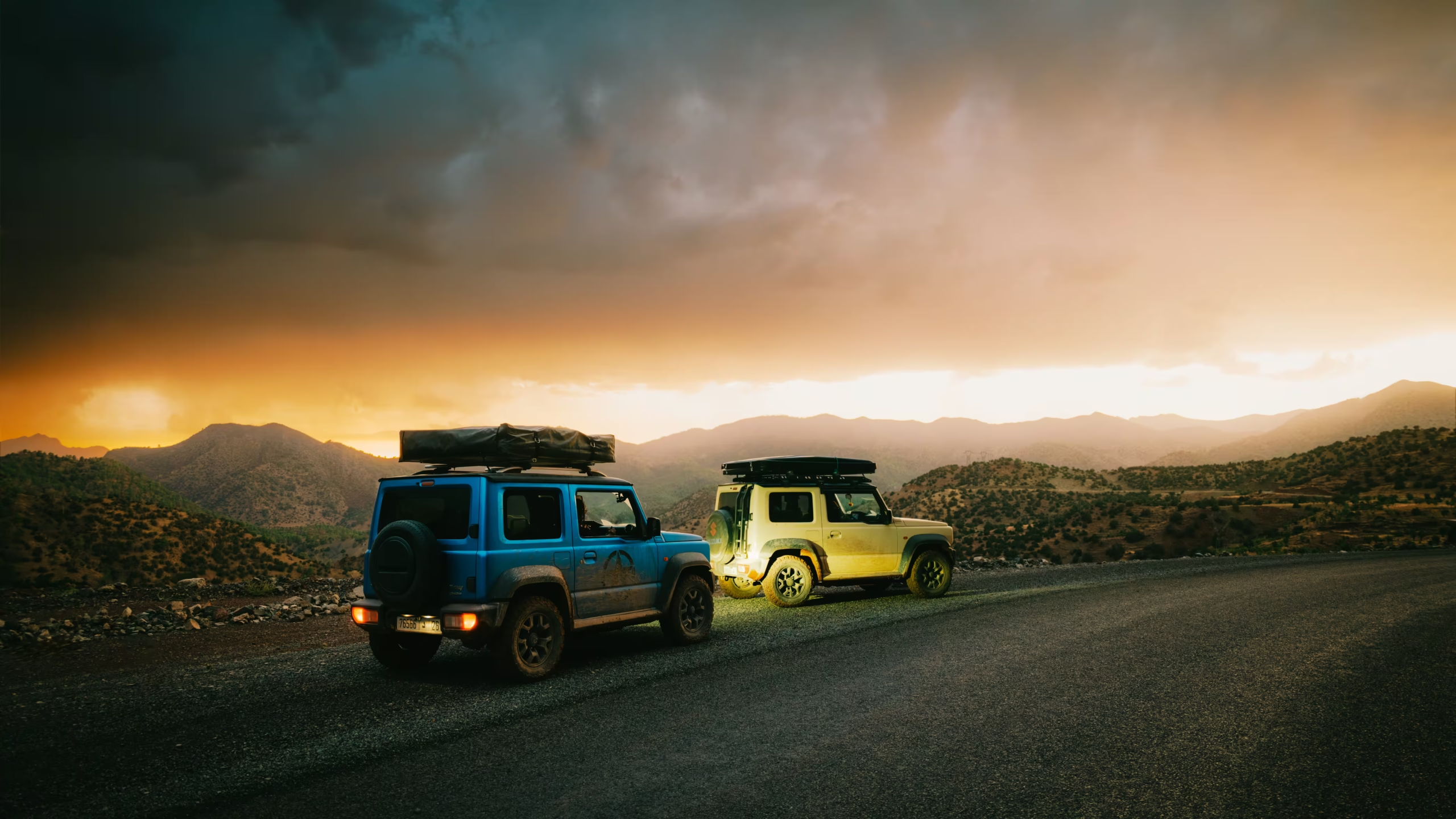
"Does my driving license work in Morocco?" "What are the speed limits on the national roads?" "Can I have a glass of wine with dinner?" "What do I do if the police stop me?"
These are the four questions we hear every week when handing over a vehicle at the counter. They seem simple, but each one hides a detail that can turn a great trip into a bad experience — especially the third one, which catches out the majority of English-speaking tourists.
This guide answers every question tourists ask about driving in Morocco in 2026, with verified data, the perspective of a rental operator who sees the same situations daily, and a dedicated section on driving a 4x4 off the paved roads.
Driving License: What You Need to Have
Your national driving license is accepted in most cases. Morocco recognizes licenses issued in countries signatory to the Vienna Convention on Road Traffic — this includes the United Kingdom, United States, Canada, Australia, New Zealand, Ireland, South Africa, and most European countries. Provided your license is valid and written in Latin alphabet, it is legally accepted in Morocco for a period of one year from your date of entry into the country.
International Driving Permit (IDP): when is it useful? For nationals of the countries listed above, the IDP is not legally required. However, it remains strongly recommended for two practical reasons: many rental agencies ask for it to validate the contract, and it simplifies police checks by providing an official translation of your license. It is inexpensive to obtain in your home country (typically £5.50 in the UK, $20 in the US, around CAD $25 in Canada) and processed within a few days.
The IDP becomes mandatory if your national license is written in a non-Latin alphabet: Arabic, Cyrillic, Chinese, Japanese, Korean. In this case, a certified Arabic or French translation may also be acceptable.
Rental agency requirements : Beyond the license itself, serious rental operators in Morocco apply standardized rules: driver must be at least 21 years old, hold a license for at least 2 years, and present a credit card in the main driver's name for the deposit. These conditions appear in our rental terms, as they do with all professional rental operators in the sector.
Without these three elements, no vehicle can be handed over to you — regardless of the agency and regardless of the booking you've paid in advance.
Documents to Keep in the Vehicle at All Times
Once behind the wheel, certain documents must be present in the car at every moment. A check can happen anywhere — here's the verified list:
| Document | Status | Notes |
|---|---|---|
| National driving license | Mandatory | Original, valid |
| International Driving Permit (IDP) | Recommended | Mandatory if license is in non-Latin script |
| Passport | Mandatory | Original, for non-Moroccans |
| Vehicle registration | Mandatory | Provided by the rental agency, kept in vehicle |
| Insurance certificate | Mandatory | Provided by the rental agency |
| Rental contract | Mandatory | Proof of authorization to drive |
The last three documents are prepared and left in the vehicle by the rental agency at pickup. Check that they are physically present in the glove compartment before driving off — it's a standard verification no traveler should skip.
Moroccan Road Rules: What You Need to Know
The Moroccan Highway Code (Law 52-05) broadly follows European standards, with some notable differences. Here are the rules that really matter.
Speed Limits
Maximum authorized speeds in 2026, by road type:
| Road type | Maximum speed |
|---|---|
| Highway | 120 km/h (75 mph) |
| National road | 100 km/h (62 mph) |
| Secondary road | 80 km/h (50 mph) |
| Urban areas / towns | 60 km/h (37 mph) |
| School zones | 40 km/h (25 mph) |
Speeding fines are officially structured in three classes by NARSA (the National Road Safety Agency), with amounts that vary based on payment timing — the sooner you pay, the less you pay:
| Speed over limit | Classification | Payment within 24h | Within 15 days | After 15 days |
|---|---|---|---|---|
| Less than 20 km/h over limit | Class 3 | 150 DH (~€14) | 200 DH (~€19) | 300 DH (~€28) |
| 20 to 30 km/h over limit | Class 2 | 300 DH (~€28) | 350 DH (~€33) | 500 DH (~€47) |
| 30 to 50 km/h over limit | Class 1 | 400 DH (~€37) | 500 DH (~€47) | 700 DH (~€65) |
| 50 km/h or more over limit | Criminal offence | Court proceedings | - | - |
Exceeding the limit by 50 km/h or more constitutes a criminal offence under Law 52-05, and may result in immediate license suspension, vehicle impoundment, and prosecution.
Automatic speed cameras are numerous on motorways A1, A3, and A7, as well as at town entrances. Mobile speed checks can happen anywhere — vigilance must be constant, particularly at transitions between national road (100 km/h) and urban areas (60 km/h).
Drink-Driving: Far Stricter Than in English-Speaking Countries
This is the point that catches out the most English-speaking tourists, by a wide margin.
The maximum legal blood alcohol content (BAC) in Morocco is 0.02% (0.20 g/l of blood, or 0.10 mg/l of exhaled air). That's effectively near-zero tolerance — even half a glass of wine may push an average-sized adult over this threshold.
- United States (most states): 0.08% BAC
- United Kingdom (England, Wales, Northern Ireland): 0.08% BAC
- Morocco: 0.02% BAC
In concrete terms: Morocco's limit is four times stricter than in the US or UK (England/Wales), and more than twice as strict as Scotland's. The rule to remember is simple and absolute — if you're driving in Morocco, you don't drink at all. Not a single beer, not one glass of wine with dinner, not even a nightcap before driving back to your hotel.
Sanctions are severe, and officially classified as a criminal offence by NARSA (court proceedings, not simple traffic ticket): fine of 5,000 to 10,000 DH (approximately €470 to €940), possible imprisonment of 6 to 12 months, and license suspension of 6 to 12 months. In the case of repeat offences, these penalties are doubled. Refusing a breathalyzer test is also a criminal offence in its own right.
A critical additional point: your rental insurance covers no damage in the event of a positive blood alcohol test. An accident with any level above the threshold means you pay for all damages — no cap, no deductible, no negotiation.
Seatbelts, Phones, and Lights: The Standard Rules
Seatbelts mandatory for all occupants, front and rear. This rule is often ignored by tourists who mistakenly believe it only applies to front seats. Classified as a Class 2 offence (300 to 500 DH depending on payment timing).
Phone use at the wheel prohibited, including with hands-free kits according to a strict interpretation of the code — though Bluetooth kits are generally tolerated in practice. Same classification as seatbelts: Class 2 (300 to 500 DH). The prudent approach is to pull over for any non-urgent call.
Dipped headlights mandatory day and night outside urban areas, on all national and secondary roads. An easy infraction to commit and regularly sanctioned.
Helmet mandatory for riders and passengers of motorized two-wheelers.
Transporting children: children under 10 years of age are prohibited from sitting in the front passenger seat (Class 2 offence).
Police Checks and Fines: What You Need to Know
Police (National Security) and Royal Gendarmerie checkpoints are frequent in Morocco — this is a routine aspect of the country, not a threat. They happen primarily at town entrances, at main junctions on national roads, and along major routes in the south.
The right approach is simple : Slow down as soon as the checkpoint is visible, pull over cleanly, switch off the engine, prepare your documents (license, passport, rental contract, vehicle registration, insurance certificate), and wait calmly. Respond politely to the questions asked, in French or English (French is understood almost everywhere; English in tourist areas).
Speed cameras : Fixed on motorways and at town entrances, usually indicated by signs. Mobile units used by the Gendarmerie — never signposted, most often positioned on downhill stretches or just after a speed zone transition.
In the event of an officially recorded infraction, you will be issued a fine with an official receipt. The NARSA fine structure applies an important rule: the sooner you pay, the less you pay. Three payment tiers exist for Class 1, 2 and 3 offences :
- Payment within 24 hours : minimum amount (150 to 400 DH depending on class)
- Payment within 15 days : intermediate amount (200 to 500 DH)
- Payment after 15 days : maximum amount (300 to 700 DH)
Always keep the official receipt you are given — it confirms that the fine has been settled through proper channels.
If a situation seems irregular (demand without receipt, unclear amount), it is legitimate to politely request the official receipt and, if necessary, contact the tourist police brigade (number displayed in most tourist areas: +212 5 37 71 68 68) or your rental agency for clarification. No tourist is required to pay a fine without written justification.
Moroccan Driving Quirks That Surprise Tourists
A few local practices to understand before hitting the road :
The expressive horn : Unlike in the UK, US or Australia, honking in Morocco isn't a sign of aggression — it's a constant tool of communication. Drivers use it to announce an overtake, signal their presence around a blind corner, say thanks, or simply say "I'm here." Don't take it personally.
Carts, mopeds, and bicycles : Very common on secondary roads and on the outskirts of towns, often poorly lit. Always anticipate their presence, particularly at dusk.
Unpredictable pedestrians and children : In villages along national roads, crossings can happen suddenly. Common-sense rule: drive at reduced speed through any built-up area, however small, with or without signage.
Reversed roundabouts : In Casablanca and some older towns, priority within the roundabout goes to the vehicle entering (right of way to entering traffic), not to the vehicle already circulating. Maximum caution on first encounter — watch the locals before committing.
Two lanes used as three : On major national roads, it's common for a vehicle to straddle the centre line to allow others to overtake on the left lane. An unusual practice that works smoothly once understood.
Night driving outside motorways : Poor signage, stray animals (donkeys, dogs, camels in the south), vehicles with poor lighting or stopped without warning. Always plan your itinerary to reach your destination before nightfall — see our guide to the best season for a 4x4 road trip in Morocco for sunset timings by period.
Driving a 4x4 Off the Paved Roads: The Specific Framework
This is the most important point for anyone planning a raid in the Moroccan south, and it's almost always overlooked in generic articles.
The universal contractual clause : All rental contracts in Morocco — without exception at serious rental operators — prohibit driving on unpaved tracks (pistes) with a vehicle that is not a 4x4. This is explicitly written in the general terms and conditions, including at discount rental agencies that offer cheap sedans. In concrete terms: driving a city car on the track to Merzouga, Chegaga, or Fint Oasis puts the driver in contractual violation, which completely voids insurance coverage in the event of damage.
What changes with a proper rented 4x4 : Tracks are contractually covered (subject to reasonable use of the vehicle and respect for authorized zones). This is one of the real economic advantages of renting a professional 4x4 — sometimes more expensive per day, but covered where it matters most for your trip. Our budget guide to 4x4 rental in Morocco breaks down this comparison.
Vigilance points on tracks : Drive through villages at very low speed (the safety of children matters more than your schedule). Respect herds crossing the road (camels, sheep, goats — they have de facto priority, otherwise accident). Never force your way through a flooded wadi — wait or turn back. Adjust tire pressure to the terrain. For foundational technique, our guide to driving a 4x4 off-road in Morocco covers the essentials.
Restricted zones : Some border areas require specific authorizations. The extreme south beyond Zagora toward the Algerian border, as well as certain tracks near the Mauritanian border, are subject to military checkpoints. If in doubt about your itinerary, your rental agency or local authorities can advise.
Article updated in 2026. The fine amounts mentioned are those officially established by NARSA (National Road Safety Agency) according to Classes 1, 2, and 3 of Law 52-05 (Moroccan Highway Code). Always verify recent regulatory updates before your trip on the official NARSA website.


