The track had been billed as "easy." A few kilometres earlier, the ground was still rolling, almost reassuring. Then, without warning, the terrain changes. The stones grow sharper, the ruts deepen, the wheels begin to spin in fits and starts. You instinctively slow down, searching for grip… and that's when the doubt sets in. You're indeed in a 4x4 — but are you actually driving it?
Off-road, the setting leaves no room for improvisation. Every poorly measured burst of acceleration, every line chosen too hastily, every transmission mode engaged at the wrong moment leaves a mark — sometimes on the vehicle, sometimes on your progress, sometimes on your safety. Unlike the road, there's no hard shoulder or immediate assistance. The terrain sets the rules, and it doesn't forgive approximations.
This article is aimed at those who want to go beyond the basics, to understand what's really at stake when the ground gives way beneath the tyres, and to adopt a considered, methodical, and professional driving approach. Here, we're not talking about performance or speed, but about mastery, anticipation, and respect for the terrain. Because in a 4x4, it isn't power that decides how far you'll get — it's your ability to read, understand, and act at the right moment.
4x4 Driving: A Technical Discipline, Not Just a Mode of Transport
At first glance, all vehicles that sit high on their wheels seem capable of leaving the tarmac. Yet the difference between a road-going SUV and a genuine 4x4 appears within the very first metres off-road. Where the SUV prioritises comfort and electronic assistance for mainly urban use, the 4x4 is built to take a beating, to clear obstacles, and to last. A separate chassis, a transfer case, low gearing, suspension travel, and mechanical underbody protection aren't cosmetic options: they're working tools against the terrain.
But owning these tools isn't enough. Off-road driving demands a methodical approach, built on anticipation and composure. Every obstacle is prepared for before the wheels even reach it. Accelerating too early, braking too late, or correcting a line abruptly are road reflexes that become mistakes on a track. In a 4x4, the driver must think ahead, accept slowing down, and sometimes give up.
Faced with mechanical limits, the driver's role is central. A 4x4, even well equipped, is never invincible. It's the human who decides when to engage a low gear, when to make use of engine torque, or when to spare the mechanics rather than force a passage.
In Morocco, this discipline takes on its full meaning. The terrain here is extraordinarily diverse: the punishing tracks of the Atlas, the deep sand of the desert, unpredictable wadis, long distances without assistance. Isolation and climatic conditions reinforce a simple reality: here, 4x4 driving isn't a comfort, it's a skill.
Understanding How a 4x4 Behaves Before Tackling the Terrain
Before even talking about obstacle-clearing techniques, you have to accept a reality that's often underestimated: a 4x4 is a heavy vehicle, and its mass dictates a large part of its behaviour. On a track, inertia is non-negotiable. Late braking, an overly abrupt line correction, or excess speed on broken terrain are paid for immediately. The more heavily the vehicle is loaded, the more these reactions are amplified, making the driving imprecise and sometimes dangerous.
The centre of gravity, naturally higher than that of a passenger car, calls for constant vigilance, particularly on side slopes. On an inclined track, the weight transfers outward, reducing your safety margin. It isn't the slope that creates the risk, but the combination of incline, speed, and stray steering-wheel movements. The rule is simple: progress slowly, with measured movements, and accept going around rather than forcing your way through.
Another fundamental point is the distinction between traction and grip. Traction is the vehicle's ability to transmit power to the wheels, while grip depends on the actual contact between tyre and ground. A 4x4 may have a high-performing drivetrain, but without grip — loose sand, wet rocks, mud — progress becomes a matter of chance. Understanding this difference lets you adapt your driving rather than compensate with excessive acceleration.
Suspension travel also plays a key role, particularly during cross-axle situations. The more the wheels stay in contact with the ground, the more constant the traction. When one of them lifts, managing torque and locking becomes decisive.
Finally, low-end engine torque is the main ally of off-roading. It allows you to clear obstacles slowly, without jerks, preserving both the mechanics and the grip. In a 4x4, mastery comes through smoothness — never through haste.
Transmission and Traction: Knowing When and How to Engage the 4x4
Off-road, the transmission isn't a mere secondary setting: it's the heart of your ability to make progress. Knowing when to engage the 4x4, and above all how to use it, often makes the difference between a controlled passage and a stranded vehicle. A bad decision is felt immediately in traction, but also in mechanical fatigue.
The transmission modes (2H, 4H, 4L)
Each mode answers a precise logic.
- 2H is intended for roads and rolling tracks. It limits fuel consumption and mechanical wear, but quickly becomes insufficient as soon as the ground deteriorates.
- 4H is used on loose or slippery terrain: sand, stony tracks, wet areas. It improves traction without changing the gearing ratio, provided you keep your driving smooth.
- 4L, or low range, is reserved for technical sections: rock crawling, steep slopes, deep ruts. It lets you drive slowly while making use of low-end engine torque.
A poor choice of mode can lead to excessive wheelspin, loss of control, or needless strain on the transmission. In real conditions, switching between modes should always be done at a standstill or at very low speed, according to the vehicle's specifications, and never under load.
Differentials and locks
- The open differential allows the wheels on the same axle to turn at different speeds — indispensable on the road but limiting off-road.
- The limited-slip differential improves traction when a wheel loses grip, without direct driver intervention.
- The full lock, for its part, locks together the wheels on the same axle. It provides maximum traction, but must be used with caution — only in a straight line or at very low speed — otherwise it puts heavy strain on the mechanics.
Used badly, locks can cause breakages, loss of steering, or premature wear of the drivetrain components.
Field case: rock crawling at low speed (Ford Ranger Raptor 2025)
On a rocky section of the High Atlas, the Ford Ranger Raptor 2026 perfectly illustrates the balance between technology and mastery. Low range is engaged, the locks activated at the opportune moment. The long-travel suspension keeps the wheels in contact with the ground, while the front camera lets you see the rocks that are invisible from the driver's seat.
Yet despite these aids, nothing is automatic. The driver moves slowly, adjusts each line, meters the throttle precisely. Technology makes reading and progress easier, but the final decision remains human. It's this combination — high-performing tools and controlled judgement — that lets you clear obstacles without forcing, respecting both the terrain and the mechanics.
Reading the Terrain: The Skill That Makes the Difference
Off-road, the ground is never fixed. It evolves, transforms, and can turn treacherous within a few metres. Reading the terrain means accepting that the success of a passage is determined before the wheels even engage. This skill, often acquired with experience, separates the driver who is subject to the track from the one who masters it.
Observe, analyse, choose your line
The first step is to observe. Spot the load-bearing zones — compact ground, stable rocks, hard sand — and identify the potential traps: unstable stones, soft sand, hidden holes, or deep ruts. This reading is done on foot when possible, or at very low speed, taking the time to assess every detail.
Then comes the choice of line. Off-road, the shortest line is almost never the best. It's about positioning the wheels so as to preserve grip, limit excessive cross-axling, and avoid impacts under the vehicle. A good line is chosen before committing, because correcting mid-passage quickly becomes complicated.
Finally, the driver must anticipate how the ground will evolve. A dry track can turn slippery in the shade, load-bearing sand can give way under the vehicle's weight, a stable stone can tip under the wheel. Reading the terrain means accepting this uncertainty and constantly adapting your speed and choices.
Field case: visual assistance on a technical passage (Ford Ranger Raptor 2025)
On a technical passage at low speed, the Ford Ranger Raptor 2025 provides valuable help thanks to its front off-road camera. It lets you see precisely the obstacles located in front of the wheels, particularly during rock crawling where visibility from the driver's seat is limited. This assistance makes placement easier and reduces the risk of contact.
But the camera never replaces human analysis. It perceives neither the stability of a rock nor how the ground will evolve a few metres further on. The driver must interpret the image, cross-reference the information with their own feel, and decide on the pace of progress.
The lesson is clear: electronic aids are tools, useful and reassuring, but it's always the reading of the terrain, the anticipation, and the driver's judgement that make the difference between a controlled passage and a complicated situation.
Managing Obstacles: Professional Clearing Techniques
Off-road, obstacles are never tackled on a whim. Every difficulty demands a method, a rhythm, and sometimes a rethink. The rule is simple: it isn't the obstacle that decides the difficulty, but the way it's approached. Professional techniques rest on slowness, precision, and the ability to give up when the conditions aren't right.
Clearing rocks and technical passages
Rocky passages require a slow, perfectly controlled approach. The goal isn't to get through fast, but to keep constant control of your line and your grip. Precise wheel placement lets you avoid impacts under the chassis and limit excessive cross-axling, which can lead to a loss of traction.
In the High Atlas, on a narrow rocky passage, the Ford Ranger Raptor 2025 demonstrates the full usefulness of engine torque available at low revs and of long-travel suspension. In low range, the vehicle progresses slowly, wheel by wheel, while the driver adjusts every movement to within a centimetre. Here, patience is the key: forcing would only make the situation worse.
Climbing and descending a steep slope
A steep slope is prepared for before you even commit. The climb requires choosing the right gear, correctly aligning the vehicle, and precisely managing momentum. Too little acceleration strands the 4x4; too much momentum increases the risk of losing control.
The descent is often trickier. On a stony slope, the Ford Ranger Raptor 2025 uses Hill Descent Control to maintain a constant speed, while the driver concentrates on the line. Engine braking remains the main tool, with the brakes serving only as a supplement. The goal is to descend slowly, without jerks, keeping the vehicle perfectly stable.
Deep ruts and degraded terrain
Ruts directly test the vehicle's centre of gravity. Abrupt steering-wheel movements or sudden acceleration can cause an imbalance that's hard to recover from. Progress must be smooth, with constant attention paid to lateral tilt.
After rain, on a heavily degraded track, the Toyota Hilux illustrates the importance of mechanical robustness. Its chassis and underbody protection absorb the strain, but the driver remains in charge of the most important decision: knowing when to give up when the risk becomes too high.
Driving in sand and dunes
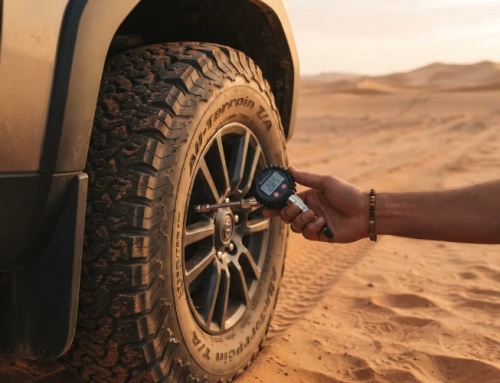
Sand imposes its own rules. Before entering the dunes, adjusting tyre pressure is essential to increase the contact patch. Reading the dunes — their shape, the wind direction, the texture of the sand — determines the choice of line.
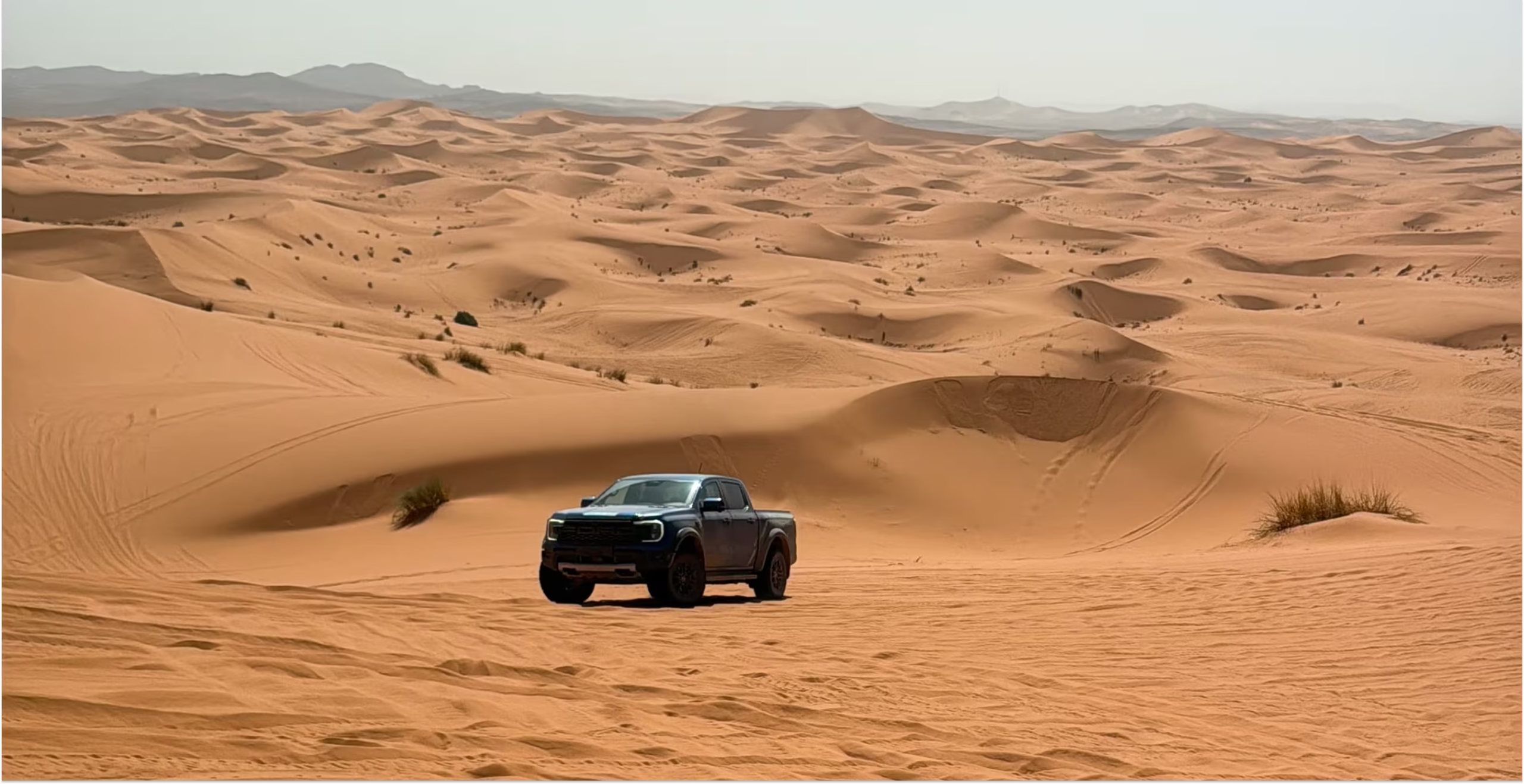
In the dunes, the Ford Ranger Raptor 2025 makes use of Sand and Baja modes to manage wheelspin and maintain momentum. The driver keeps a constant speed, anticipates each crest, and avoids sudden braking. In case of getting bogged down, method takes precedence over force: gradual freeing, torque management, and readjustment of tyre pressure.
Crossing a wadi or a wet zone
A wadi is never crossed without prior assessment. You have to gauge the depth, observe the nature of the bed, and judge the strength of the current. A reconnaissance on foot often avoids costly mistakes.
The crossing technique rests on a gentle entry, a constant speed, and a gradual exit. The mechanical risks — water entering the air intake, damage to electrical components — are real. After the crossing, checks are in order: brakes, transmission, water level, and general state of the vehicle.
Off-road, managing obstacles doesn't mean systematically taking them on, but choosing the ones you can clear with method, mastery, and respect for the terrain.
Vehicle Control: Precision Over Power
Off-road, raw power is rarely the answer. What makes the difference is the ability to control the vehicle with finesse, to maintain the balance between traction, grip, and stability. Precise driving reduces mechanical strain, limits loss of grip, and considerably increases safety, especially on technical and isolated terrain.
Metering the throttle and engine braking
Progressiveness is the golden rule. Acceleration that's too sharp causes wheelspin, degrades the terrain, and needlessly tires the transmission. Conversely, a lack of momentum can strand the vehicle in a critical zone. Correct metering means making use of low-end engine torque, letting the vehicle move forward naturally, without jerks.
Engine braking plays a central role, particularly downhill or on slippery terrain. It lets you control speed without locking the wheels, unlike excessive braking which can lead to a loss of steering. The common mistakes remain the same: sharp acceleration to "get out" of a situation, late braking, or line corrections that are too quick — all inherited from road driving.
Field case: assisted low-speed driving (Ford Ranger Raptor 2025)
On a technical passage at low speed, the Ford Ranger Raptor 2025 showcases Trail Control, a system that automatically maintains a slow, constant speed. This assistance lets the driver concentrate fully on the line, wheel placement, and reading the terrain, without constantly worrying about the throttle and the brake.
However, even with this aid, control remains human. Trail Control anticipates neither how the ground will evolve nor the stability of an obstacle. It makes managing the pace easier, but replaces neither experience nor judgement. The limit of driver aids is clear: they support the driver's precision, they don't create it.
The Mistakes That Even Experienced Drivers Make
Experience reduces risk, but it never immunises against error. Off-road, certain bad decisions come up regularly, even among seasoned drivers. The most frequent remains excess speed or momentum. Trying to "bulldoze through" may seem effective in the moment, but it often leads to a loss of control, mechanical impacts, or a bogging-down that's hard to correct.
Another common mistake: the poor use of differential locks. Engaging them too early, for too long, or in unsuitable conditions creates significant strain on the transmission and can reduce steering ability. Locks are powerful tools, but they demand method and discernment.
Excessive reliance on technology is a modern trap. Cameras, driving modes, and driver aids give a sense of security, but they can mask a poor reading of the terrain or insufficient anticipation. Finally, overestimating the vehicle's robustness remains the costliest mistake. Even a 4x4 reputed to be indestructible has its limits. The terrain always ends up reminding you that the mechanics must be respected.
Safety and Preparation: Thinking Like a Professional
In 4x4 driving, safety begins well before you enter the track. Thinking like a professional means treating preparation as a stage every bit as important as the driving itself.
Preparing the vehicle before entering the track
A complete mechanical inspection is a must: fluid levels, brake condition, the fastening of suspension components, and a check of the transmission. Tyre pressure must be suited to the terrain — lower on sand, slightly adjusted on broken tracks — while remaining consistent with the vehicle's load.
Cooling and fuel management are often neglected. In hot or isolated conditions, an overworked engine and a poorly estimated range can quickly become critical. Add to that the essential equipment: a spare wheel in good condition, sand-recovery gear, basic tools, a means of communication, and a sufficient quantity of water.
Field case: endurance and reliability in extreme conditions (Toyota Hilux)
In demanding environments, the Toyota Hilux has established itself as a benchmark for endurance. Its front and underbody protection allow it to absorb repeated impacts on broken tracks, while its mechanical reliability is recognised over long distances.
This reputation isn't theoretical. The Hilux has been entered in competition, notably at the Rallye Aïcha des Gazelles, where it served as the race vehicle for crew 186 (Marine BOUHOUR and Virginie GUERIN), demonstrating that preparation and reliability take precedence over power. In these extreme conditions, every detail counts: settings, protection, anticipation.
The lesson is clear: preparation turns a good vehicle into a reliable tool, capable of taking on the terrain without compromising on safety.
Driving a 4x4 in Morocco: Choosing the Vehicle Suited to Your Level
Morocco offers an exceptional diversity of terrain, but this richness calls for a considered choice of vehicle. Driving a 4x4 suited to your experience level isn't a question of prestige or power, but of coherence between the driver, the terrain, and the goals of the trip. A well-chosen vehicle makes progress easier, reduces risk, and turns the experience into a discovery rather than an ordeal.
Field case: discovering off-roading with confidence (Toyota Prado)
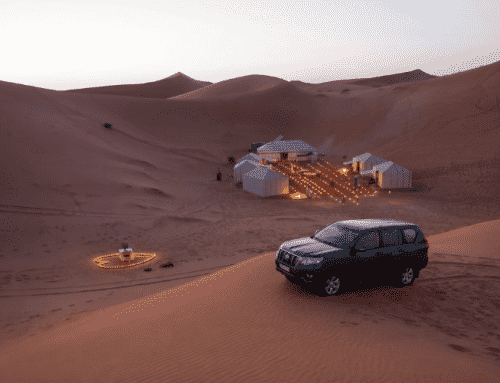
For amateur drivers or travellers wishing to explore without pressure, the Toyota Prado represents an ideal balance. Its comfort and stability let you rack up the kilometres on the track without excessive fatigue, while offering genuine off-road capability. The all-wheel drive, combined with well-calibrated driver aids, reassures without masking the terrain's reactions.
On a mixed track combining sand, stones, and irregular passages, the Prado progresses with serenity. It doesn't seek performance, but consistency. This versatility makes it a vehicle perfectly suited to those discovering off-roading or wishing to travel far, taking the time to observe and understand the Moroccan landscape.
Field case: matching the vehicle to the terrain
Every 4x4 has its area of predilection. The Toyota Hilux stands out over long distances and on demanding tracks. Its robustness, reliability, and ability to absorb strain make it a top ally for committed itineraries and difficult conditions.
The Ford Ranger Raptor, for its part, excels on technical passages and in dynamic driving. Advanced suspension, electronic aids, and driving precision let you tackle complex terrain with mastery — provided you stay methodical.
The Toyota Prado positions itself as the vehicle of exploration and versatility. It accompanies the driver in a more gradual approach to off-roading, without sacrificing comfort or safety.
Conclusion: Mastery Before Performance
Driving a 4x4, especially in Morocco, isn't a display of power, but an exercise in mastery and discernment. Technique always takes precedence over horsepower, and technology, however advanced, remains a tool at the driver's service — never an automatic solution.
Respecting the terrain, understanding the vehicle's limits, and anticipating every situation are the foundations of successful driving. It's this approach that lets you explore Morocco safely, fully enjoy its landscapes, and turn every track into a controlled experience.
Whether you're an amateur or an experienced driver, choosing the right 4x4 and preparing properly make all the difference. Exploring Morocco starts with a simple decision: driving methodically, and choosing a vehicle equal to the terrain you want to discover.